
Have you ever walked out of a job interview feeling fantastic—you nailed every technical question, gave articulate answers, and felt a real connection with the hiring manager—only to receive a polite rejection email a few days later? If this scenario sounds frustratingly familiar, you are likely overlooking the single most critical factor in successful communication non-verbal cues.
The truth is, your success in a high-stakes setting like a professional interview relies far less on what you say and far more on how you say it. This phenomenon is perfectly captured by the groundbreaking 7-38-55 Rule for Job Interview, a powerful psychological framework that dissects the components of face-to-face communication. Mastering the 7-38-55 Rule for Job Interviews isn’t just a recommendation; it’s the secret weapon of confident, highly desirable candidates. By prioritizing your body language and vocal delivery, you can profoundly influence the interviewer’s perception of your competence and confidence, securing your next career move.
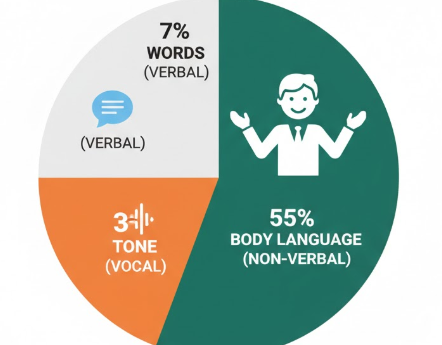
What is the 7-38-55 Rule and Why Does it Matter in Interviews?
The 7-38-55 Rule (also known as the Mehrabian Formula, named after psychologist Dr. Albert Mehrabian) is a crucial model for understanding interpersonal communication, particularly when a speaker’s words, tone, and body language are incongruent (or misaligned).
The formula states that the total impact of a message is broken down into three distinct elements:
- 7% Verbal: The actual words spoken.
- 38% Vocal: The tone of voice, pitch, and speed.
- 55% Non-Verbal: Body language, facial expressions, and posture.
In the context of a job interview, this breakdown reveals a shocking reality: your beautifully crafted answers account for only a tiny fraction (7%) of the impression you leave. The vast majority of your perceived competence—a full 93%—is determined by the silent signals you are sending.
The 7% (Verbal): The Words You Choose
While only 7% of the total impact, the verbal component is still essential as it provides the core content of your response.
Key Optimization Points:
- Clarity and Conciseness: Deliver clear, structured answers. Interviewers appreciate candidates who get straight to the point.
- Keywords: Use industry-specific terminology to show subject matter expertise.
- Storytelling: Structure your answers using frameworks like the STAR method (Situation, Task, Action, Result) to provide compelling narratives of your achievements.
- Internal Link: Check out our guide on STAR Method
The 38% (Vocalics): The Power of Your Tone
The vocal component encompasses the subtle nuances of your voice that convey emotion and intent. This 38% is often the bridge between your words and your body language.
| Vocal Trait | What It Conveys | Actionable Tip |
| Pace | Control, thoughtfulness | Speak slightly slower than normal; avoid rushing. |
| Pitch | Excitement, nervousness | Use a moderate, controlled pitch; avoid talking too high when nervous. |
| Volume | Confidence, authority | Speak loud enough to be clearly heard without shouting. |
| Silence | Composure, reflection | Embrace brief pauses to collect your thoughts before responding. |
The 55% (Non-Verbal): Body Language Decides Your Fate
This is where most candidates make mistakes. The 55% component is the deciding factor because, in moments of high stress (like an interview), non-verbal signals are often seen as the most truthful indicators of a person’s true feelings, attitude, and character. Interviewers subconsciously interpret your body language as a proxy for your confidence, professionalism, and interest in the role. If your body language screams “nervous and unsure,” it completely undermines even the most articulate 7% answer.
By focusing on the 7-38-55 Rule for Job Interviews, you address this conflict head-on, ensuring your non-verbal communication validates your verbal claims, thereby boosting your perceived credibility and eliminating the common reasons for post-interview rejection.
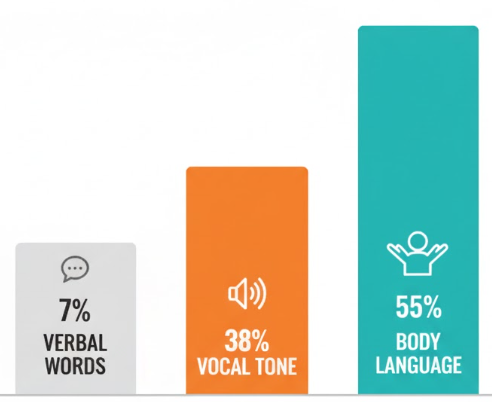
Mastering the 55%: Essential Body Language Tips to Ace Your Interview
The non-verbal realm is often the easiest to fix but the most commonly neglected. Addressing the 55% is crucial for utilizing the full potential of the 7-38-55 Rule for Job Interviews. Many job seekers lose the hiring opportunity due to simple, correctable non-verbal mistakes.
Crucial Body Language Cues During the Interview (5 Mistakes to Avoid)
Data shows that poor body language accounts for a significant portion of interview failure. Here are the top five areas to focus on, ensuring you don’t fall into the common traps:
1. Poor Eye Contact (The 67% Failure Point)
A lack of appropriate eye contact is one of the quickest ways to signal dishonesty, lack of interest, or low confidence.
- Do This: Maintain eye contact for several seconds at a time (3-5 seconds), then briefly look away to collect your thoughts, and return the gaze. This makes you appear thoughtful and sincere.
- Avoid This: Staring intensely without blinking (creepy) or looking down/around the room (disinterested).
2. Excessive Hand or Body Activity (The 45% Failure Point)
Fidgeting, excessive movement, or nervous tapping detracts from your message and suggests deep anxiety.
- Do This: Use your hands purposefully when making a key point (gestures should be open and controlled). When listening, keep your hands comfortably folded on your lap or resting on the table, palms down.
- Avoid This: Tapping your foot, clicking a pen, playing with your hair, or rubbing your hands together incessantly.
3. The Handshake (The 30% Failure Point)
The handshake is usually the first and last physical interaction, setting the tone for the entire interview.
- Do This: Stand up, initiate firm contact, use a complete grip (web-to-web), shake briefly (2-3 seconds), and maintain eye contact.
- Avoid This: The “dead fish” (limp) handshake or the “bone crusher” (overly aggressive) grip. Note: For virtual interviews, simply a confident wave and smile replaces this.
4. Sitting Posture (The 40% Failure Point)
Your posture instantly communicates your energy level and overall professionalism.
- Do This: Sit upright, maintaining a straight spine. Lean slightly forward (about 10 degrees) to signal engagement and interest. Keep both feet flat on the floor or crossed neatly at the ankles.
- Avoid This: Slouching (lack of enthusiasm), leaning too far back (boredom), or crossing your arms tightly across your chest (defensiveness).
5. Facial Expressions
Your face is the most expressive part of your body. Ensure your expressions match the content of your words.
- Do This: Start and end the interview with a genuine smile. Nod occasionally to show you are actively listening. Use appropriate expressions (serious when discussing a challenge, pleased when discussing an accomplishment).
- Avoid This: A blank or uninterested expression.

Non-Verbal Checklist: Pre-Interview Preparation
Before you even step into the room (or log into the call), the 55% starts working.
| Checklist Item | Purpose (55% Alignment) |
| Attire | Demonstrates professionalism and respect for the company/role. |
| Grooming | Signals attention to detail and self-care. |
| Waiting Room | Maintain a poised, relaxed posture; avoid excessive phone use. |
| Materials | Have a neat notepad/folder; signals organization and preparedness. |
| Entrance | Confident walk and greeting; signals assertiveness. |
Optimizing the 38%: Cultivating the Right Vocal Tone and Confidence
The 38% element of the 7-38-55 Rule for Job Interviews is the music behind the lyrics. The most brilliant answer delivered with a meek, hesitant tone loses its impact.
Clarity, Pace, and Projection: Three Pillars of Vocal Authority
To master the 38%, focus on these areas during your practice sessions:
1. Clarity (Diction and Articulation)
- Focus: Ensure every word is distinguishable. Mumbling or swallowing words instantly lowers your credibility.
- Tip: Practice tongue twisters or read complex passages aloud to improve articulation.
2. Pace (Speed of Speech)
- Focus: A moderate pace signals calmness and thoughtful reflection. Speaking too fast suggests nervousness, while speaking too slow can imply uncertainty or lack of energy.
- Tip: When you feel nervous, consciously take a breath before answering and regulate your pace.
3. Projection (Volume)
- Focus: Your voice should be audible and strong enough to command attention without shouting. This is particularly important in virtual settings where microphones can flatten volume.
- Tip: Practice “speaking from your diaphragm” (your belly) rather than your throat to achieve a deeper, more authoritative tone.
By optimizing your vocal delivery (38%), you reinforce the confidence displayed by your body language (55%), creating a powerful, cohesive presence that elevates the meager 7% of your words.
- External Link: For a deeper dive into the origin of the rule, read this detailed breakdown from [Psychology Today on Non-Verbal Cues]([External Link: https://www.google.com/search?q=www.trustedindustrysource.com/mehrabian-rule]).
Elevating the 7%: Ensuring Your Words Align with Your Presence
Even though the verbal content is the smallest percentage, it’s the vehicle for the non-verbal cues. If the words are weak, the powerful tone and posture are wasted.
| Weak Verbal Response (7%) | Powerful Alignment (7% + 38% + 55%) |
| “I guess I am pretty good at managing projects.” | “I am confident in my ability to lead complex projects. For example, in my last role, I successfully delivered [Specific Achievement] six weeks ahead of schedule.” |
| Non-Verbal Impact: Hesitation, weak tone, shoulders slightly rounded. | Non-Verbal Impact: Direct eye contact, firm tone, open-hand gestures, and a slight forward lean. |
Conversational & Voice Search Optimization: Applying 7-38-55 to Virtual Interviews
| Communication Component | In-Person Focus | Virtual Focus |
| 55% Body Language | Full posture, handshake, leg position. | Framing, Lighting, Eye-level camera, Hand gestures (in frame). |
| 38% Vocal Tone | Projection across a room. | High-quality microphone, Controlling background noise. |
| 7% Verbal Content | Clear, unhurried speech. | Avoiding technical jargon that might cause lag/misunderstanding. |
The Power of Practice: Internalizing Non-Verbal Excellence
The best way to fully utilize the 7-38-55 Rule for Job Interviews is through relentless practice. Focus less on memorizing answers and more on rehearsing the delivery of those answers.
Actionable Practice Steps
- Record Yourself: Use your phone or webcam to record yourself answering common interview questions.
- Mock Interviews: Conduct mock interviews with friends or mentors, explicitly asking them to rate your confidence level based only on your non-verbal cues.
- Power Posing: Adopt confident postures (like standing tall with hands on your hips) for two minutes before the interview.

FAQ
Q1: Who created the 7-38-55 Rule for communication?
The 7-38-55 Rule for Job Interviews is based on the research conducted by Dr. Albert Mehrabian, a professor of psychology at the University of California, Los Angeles, in the 1960s. He originally developed the model to explain communication in situations where emotional attitudes and feelings are being discussed, highlighting the conflict that arises between verbal and non-verbal cues.
Q2: Does the 7-38-55 Rule apply to all types of communication?
No, the 7-38-55 Rule does not apply to all types of communication, such as purely factual or informational discussions (e.g., reciting a list of facts). It is specifically and most effectively applied in high-stakes, emotionally charged, and subjective settings—like a job interview or a presentation—where the interviewer is trying to gauge your attitude, confidence, and sincerity toward the subject matter and the job.
Q3: What percentage of my interview impression is based on non-verbal communication?
A combined 93% of your interview impression is based on non-verbal and vocal factors. Specifically, the non-verbal component (body language, posture, and expressions) accounts for the largest portion, a full 55%, while your vocal tone and delivery account for 38%. The words you choose make up the final 7%.
Q4: How can I improve my 55% body language immediately for a remote interview?
To immediately improve your 55% body language in a remote interview, focus on four key areas: 1) Maintain eye contact by looking directly into the camera lens, not the screen; 2) Sit tall and use an open, confident posture; 3) Keep your face framed in the middle of the camera; and 4) Smile frequently to convey warmth and enthusiasm.
Conclusion: Use the 7-38-55 Rule to Own the Room
Landing your dream role requires more than just meeting the job description requirements; it demands a comprehensive, persuasive presence. By internalizing and practicing the 7-38-55 Rule for Job Interviews, you shift your focus from merely knowing the answers to strategically managing the entire perception you project.
In the final moments of your interview, remember this: the hiring decision hinges not on the 7% of your technical knowledge, but on the 93% non-verbal confidence that confirms your fit and competence. Master your body language, refine your vocal tone, and watch as your words gain the authority they deserve. Use the 7-38-55 Rule for Job Interviews to ensure your next great interview turns into your next great job offer.
Must Read Article
Master the STAR Method Best Interview Answers Strategy (2025) Check out Now
Viksit Bharat Buildathon Hackathon 2025 upto ₹1 crore prize money pool
Why 93% of Students Want an Internship Before Taking a Job?
How to Answer: ‘Why Should We Hire You?’ – Best Examples for 2025
Easy Work From Home Jobs for Housewives – Flexible Opportunities Across India
Resume Tips AI Prompts: Smart Prompts to Build a Winning Resume in 2025
HR Interview Questions and Answers for freshers 2025
SBI Platinum Jubilee Asha Scholarship 2025 – Full Guide: Eligibility, Amount & How to Apply
Tips to Strengthen Your SBI Platinum Jubilee Asha Scholarship Application 2025
Common Mistakes to Avoid While Filling the Form of SBI Asha Foundation Scholarship
How to Calculate CTC and Salary Hike Calculator
Difference between CTC vs In hand/Take home Salary, Why this is Important in Jobs
Know Everything about CTC (Cost to Company) you need to know as a employee
Easy Work From Home Jobs for Housewives – Flexible Opportunities Across India
No Stress Online Work from home for Students Check out the list now
-
Top Skills for Work From Home Jobs in 2026
“So, is remote work still a thing in 2026?” That’s the question I get asked almost every day. The answer is a resounding yes—but the game has changed. We’ve moved past the “can you use Zoom?” era. In 2026, the top skills for work from home jobs are all about independence, advanced AI collaboration, and…
-
Where to Place Skills on Your Resume Get Noticed Now
Have you ever spent hours perfecting your bullet points, only to wonder, “Wait, where do I actually put my skills so a recruiter sees them?” You aren’t alone. One of the most common questions I get is about the literal real estate of a CV: where to place skills on your resume. If you tuck…
-
8th Pay Commission Salary Calculator: Comprehensive Guide to Expected Hikes in 2026
The anticipation surrounding the 8th Pay Commission is reaching a fever pitch as central government employees and pensioners look toward January 1, 2026. Understanding how the transition from the 7th to the 8th Central Pay Commission (CPC) will impact your monthly take-home pay is crucial for financial planning. This guide explores the mechanics of an…
-
Top Skills for Resume: 20+ High-Value Skills to Get Hired
In today’s competitive job market, your resume has about six seconds to make an impression. To land an interview, you need more than just experience; you need the right top skills for resume sections that catch the eye of both Applicant Tracking Systems (ATS) and human recruiters. Whether you are a seasoned professional or a…
-
Work From Home Holiday Expert – MakeMyTrip Jobs
The Travel Industry has undergone a massive transformation, moving from traditional offices to the convenience of your living room. For those with a passion for wanderlust and a flair for sales, the Work From Holiday expert role particularly with an industry leader like MakeMyTrip—is a dream opportunity. This isn’t just a job it’s a chance…