
Have you ever spent hours perfecting your bullet points, only to wonder, “Wait, where do I actually put my skills so a recruiter sees them?”
You aren’t alone. One of the most common questions I get is about the literal real estate of a CV: where to place skills on your resume. If you tuck them away at the very bottom, a recruiter might miss them in their six-second scan. If you put them too high without context, they look like “keyword stuffing.”
Let’s have a real conversation about how to map out your resume for maximum impact in 2026.

The “F-Pattern” and Your Skills
Have you ever heard this before? Before we dive into locations, you need to understand how recruiters read. Most people scan a page in an “F” shape—concentrating on the top, the left side, and the middle.
If your top skills for resume aren’t in those “hot zones,” you’re essentially invisible.
The Professional Summary
Think of your professional summary as the movie trailer for your career. You don’t want to list 20 skills here, but you must mention your top 3 heavy hitters.
- Instead of: “Experienced project manager with many skills.”
- Try: “Results-driven Project Manager specializing in Agile Methodologies, Budget Forecasting, and Stakeholder Communication.”
By placing skills here, you’re telling the recruiter (and the ATS) exactly who you are within the first three inches of the page.
The Dedicated Skills Sidebar vs. The Bottom Section
This is where the “Where to Place Skills on Your Resume” debate gets interesting. you will find any template where the skill section are fixed.
The Sidebar (The Modern Approach)
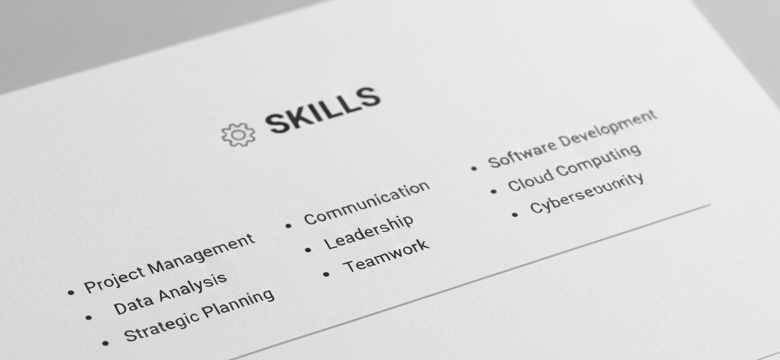
If you are using a modern template, a sidebar on the left or right is a fantastic place for technical skills. It keeps the center of the page clean for your work history while keeping your “toolbox” visible at all times. Technical skills need more attention hence, left or right sidebar makes it perfect place for eye contact on resume.
The Category Block (The ATS-Friendly Approach)
If you have a lot of technical certifications (like in IT or Engineering), a dedicated section right below your summary works best. Organize them into sub-categories like:
- Software: Python, AWS, Docker
- Methodologies: Scrum, Six Sigma, Lean
- Languages: English (Native), Spanish (Fluent)
The Work Experience Section (The “Proof”)
If I could give you only one piece of advice, it would be this: Skills without context are just words. The best place to “place” skills is actually inside your job descriptions. This is where you prove you didn’t just learn the skill—you used it to get results.
Pro Tip: Use the “Action Verb + Skill + Result” formula.
- “Leveraged Google Analytics (Skill) to identify traffic drops, resulting in a 15% increase in conversion (Result).”
Hard Skills vs. Soft Skills: Location Matters
Should you treat all skills the same? Not necessarily.
| Skill Type | Best Placement | Why? |
| Hard Skills (Software, Tools) | Dedicated Skills Section | High ATS value; easy for recruiters to check off requirements. |
| Soft Skills (Leadership, Empathy) | Work Experience Bullets | They are “show, don’t tell” skills. They need a story to be believable. |
| Hybrid Skills (SEO, Project Mgmt) | Professional Summary | Defines your professional identity immediately. |
Common Mistakes to Avoid
When deciding where to place skills on your resume, avoid these three traps:
- The “Skill Bar” Visual: Those little graphics that say you are “80% at Photoshop” are confusing. What does 80% even mean? Use words like “Expert,” “Proficient,” or “Intermediate” instead.
- Irrelevant Skills: If you’re applying for a Data Science role, your “Expertise in Grilling” shouldn’t be on there. Keep it surgical.
- The Bottom Bury: Don’t wait until the very last line to mention you speak three languages or code in Java. If it’s a job requirement, move it up!
Placement is just half the battle; choosing the right words is the other half.
MUST READ
Best Way to Prepare for a Virtual Job Interview
Master the STAR Method Best Interview Answers Strategy (2025) Check out Now
Why 93% of Students Want an Internship Before Taking a Job?
How to Answer: ‘Why Should We Hire You?’ – Best Examples for 2025
Resume Tips AI Prompts: Smart Prompts to Build a Winning Resume in 2025
HR Interview Questions and Answers for freshers 2025
The 7-38-55 Rule for Job Interviews: Master Non-Verbal Communication and Get Hired
Difference between CTC vs In hand/Take home Salary, Why this is Important in Jobs
Know Everything about CTC (Cost to Company) you need to know as a employee
FAQ
Is it okay to put my skills at the very top?
Yes, especially if you are a career changer or a technical specialist. It shows the recruiter immediately that you have the “hard” requirements for the job.
How do I handle skills for my first resume with no experience?
Place your “Skills” section right after your “Education.” Focus on skills you gained through coursework, volunteer work, or personal projects.
Should I repeat the same skill in different sections?
Yes! In fact, mentioning a core skill (like “Strategic Planning”) in your summary, your skills list, and your work experience is a great way to “SEO-optimize” your resume for ATS.
-
Top Skills for Work From Home Jobs in 2026
-
Where to Place Skills on Your Resume Get Noticed Now
-

8th Pay Commission Salary Calculator: Comprehensive Guide to Expected Hikes in 2026
-
Top Skills for Resume: 20+ High-Value Skills to Get Hired