
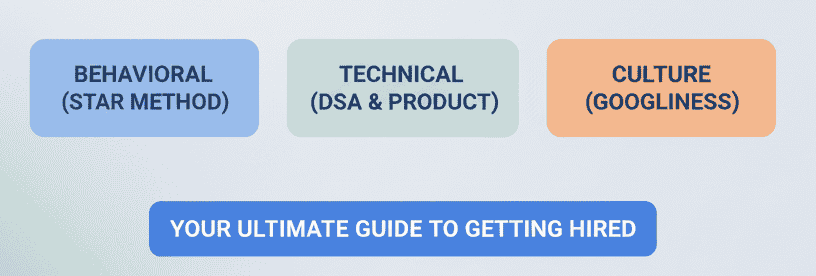
When you are preparing for google the top most tech companies to apply for jobs. you need to highly aware about the interview process at Google. Don’t underestimate the “easy” questions they are the most challenging to answer well without prior preparation and a clear, structured narrative.
Success hinges on demonstrating impact, using data, and showcasing how your past actions predict future success at one of the world’s most influential technology companies.
The Three Pillars of Google Interview Questions
Google interviews, regardless of the role (Software Engineer, Product Manager, Sales, or Operations), typically revolve around three key areas. Preparing specific, compelling answers for each is essential.

1. Behavioral & Leadership
These questions gauge your soft skills, teamwork, adaptability, and leadership qualities. Google specifically looks for “Leadership without Authority” and a candidate’s ability to handle ambiguity and failure.
| Basic Google Question | The Interviewer’s Goal | Preparation Strategy |
| Why do you want to work at Google? | Assesses your genuine passion, research, and cultural alignment (Culture Add). | Connect your long-term career goals and personal values to Google’s mission or a specific product/project. Avoid generic praise. |
| Tell me about a time you failed and what you learned. | Measures self-awareness, resilience, and growth mindset. | The focus must be on the lesson and recovery, not the mistake. Use a professional failure that had clear, measurable consequences. |
| Describe a conflict you had with a colleague and how you resolved it. | Evaluates conflict resolution, communication, and collaboration skills. | Demonstrate maturity and a focus on the shared goal. The conflict should be professional, not personal. |
| Tell me about a time you showed leadership without formal authority. | Looks for initiative, influence, and the ability to drive change from any position. | Describe an instance where you identified a problem and led a solution/process improvement without being the assigned manager. |
The STAR Method: Your Behavioral Blueprint
Google interviewers overwhelmingly prefer candidates who use the STAR method (Situation, Task, Action, Result) to structure their behavioral answers. This framework ensures your responses are detailed, focused, and quantifiable.
Technical & Foundational Questions
These questions are fundamental, especially in engineering and data roles, but even non-technical roles may face questions testing logical thinking.
- Data Structures & Algorithms (DSA) Basics: For technical roles (Software Engineer, Data Scientist), you must master basic DSA. Expect questions on common structures like Arrays, Hash Tables (HashMaps), Trees, and Graphs. The interviewers will want you to explain your choice of data structure for a given problem.
- Example Question: “Given an array of integers, find the two numbers that add up to a specific target.” (Requires knowledge of Hash Tables for optimal performance).
- Complexity Analysis: You must be able to calculate and state the Time and Space Complexity (using Big O notation, e.g., $O(n)$, $O(n^2)$, $O(\log n)$) for any solution you propose. This shows you understand efficiency at scale.
- Favorite Google Product: “What is your favorite Google product and how would you improve it?”
- Goal: Assesses product thinking. Choose a product and discuss its features, competitive advantages, and a clear, well-thought-out improvement that aligns with a business objective (e.g., “I admire Google Maps, but I would integrate real-time carbon footprint calculation for driving routes to align with Google’s sustainability goals”).
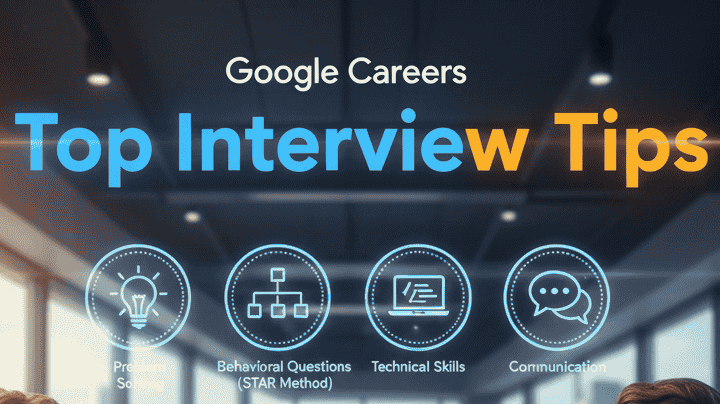
The Basic Product & Company
These questions test your understanding of Google’s business, market position, and ability to think creatively about real-world problems.
- Competitor Analysis: “Who are Google’s top competitors in the cloud space, and how does Google Cloud Platform (GCP) stand out?” (Shows market awareness.)
- Product Deprecation: “Explain how Google handles feature deprecation (e.g., shutting down a service).” (Tests empathy for users and communication skills.)
- Estimation/Puzzle Questions: Although less common today, be ready for open-ended questions like, “How many piano tuners are there in Seattle?”
- Strategy: The interviewer doesn’t care about the final number. They want to see your thought process. Break the problem into manageable estimates and state your assumptions clearly (e.g., “Assume 4 million people in Seattle, one piano for every 100 households, etc.”).
Success in answering the basic Google Interview Questions in 2025 hinges on preparation, structure, and sincerity. Focus on delivering concise, quantified STAR stories and demonstrating that you understand Google’s mission and technical expectations. Your preparation should cover not just what to answer, but how to think through a problem, showing the interviewer the future Googler you are poised to become.

By mastering the fundamentals laid out in this guide, you will be well-equipped to manage both the expected behavioral questions and the more complex technical challenges that follow.
FAQ
What are the biggest mistakes people make in a Google interview?
The biggest mistake is not explaining your thought process. Google values how you think more than the correct answer. You must talk out loud constantly, explaining your assumptions, trade-offs, and why you chose a particular solution over others.
What is “Googleyness” and how do I show it?
“Googleyness” refers to cultural alignment, which includes embracing ambiguity, intellectual humility, a strong collaborative spirit, and a drive to solve huge, important problems. You show it by demonstrating proactive initiative, genuine enthusiasm, and the ability to be a “culture add” rather than just a “culture fit.”
How should I answer “What are your weaknesses?” at Google?
Choose a genuine, non-critical professional weakness, but immediately pivot to the tangible steps you are taking to overcome it. For example: “I used to over-engineer solutions, but I now prioritize simplicity and scalability early in the design process to ensure efficient delivery.”
How long is the Google hiring process in 2025?
The full process, from initial recruiter screening to the final Hiring Committee decision and team matching, typically takes 4 to 8 weeks, though this can vary significantly based on the role and current hiring needs. Patience and consistent follow-up are key.
Must Read Article
Best Way to Prepare for a Virtual Job Interview
Google Internship Secrets: The Definitive Step-by-Step Guide to Getting Hired in 2025
Master the STAR Method Best Interview Answers Strategy (2025) Check out Now
Viksit Bharat Buildathon Hackathon 2025 upto ₹1 crore prize money pool
Why 93% of Students Want an Internship Before Taking a Job?
How to Answer: ‘Why Should We Hire You?’ – Best Examples for 2025
Easy Work From Home Jobs for Housewives – Flexible Opportunities Across India
Resume Tips AI Prompts: Smart Prompts to Build a Winning Resume in 2025
HR Interview Questions and Answers for freshers 2025
SBI Platinum Jubilee Asha Scholarship 2025 – Full Guide: Eligibility, Amount & How to Apply
Tips to Strengthen Your SBI Platinum Jubilee Asha Scholarship Application 2025
Common Mistakes to Avoid While Filling the Form of SBI Asha Foundation Scholarship
How to Calculate CTC and Salary Hike Calculator
Difference between CTC vs In hand/Take home Salary, Why this is Important in Jobs
Know Everything about CTC (Cost to Company) you need to know as a employee
Easy Work From Home Jobs for Housewives – Flexible Opportunities Across India
No Stress Online Work from home for Students Check out the list now
The 7-38-55 Rule for Job Interviews: Master Non-Verbal Communication and Get Hired